Home Structure Checklist
Get the exact Home Structure
When I first started teaching, I thought the hardest part would be the lesson planning.
It wasn’t.
The hardest part was realizing I could have the best curriculum in the world… but if I didn’t have a solid classroom management system, I couldn’t actually teach.
The room would slowly slip into chaos in ways that weren’t dramatic at first. A pencil dropped here. A side conversation there. Someone “forgetting” directions. A few kids always unsure of what to do next. And suddenly, my energy was going everywhere except where it needed to go.
I wasn’t teaching anymore—I was managing noise.
And that’s when it clicked for me: structure isn’t restrictive. Structure is what makes learning possible.
Now as a homeschool mom, I see the exact same principle at home.
A lot of parents feel overwhelmed and assume the answer is “trying harder” or “reminding more.” But what I’ve learned is the same truth applies in both spaces:
Without a clear system, everyone ends up frustrated.
Not because children are “bad” or disobedient—but because expectations are floating. Unclear. Inconsistent. Invisible.
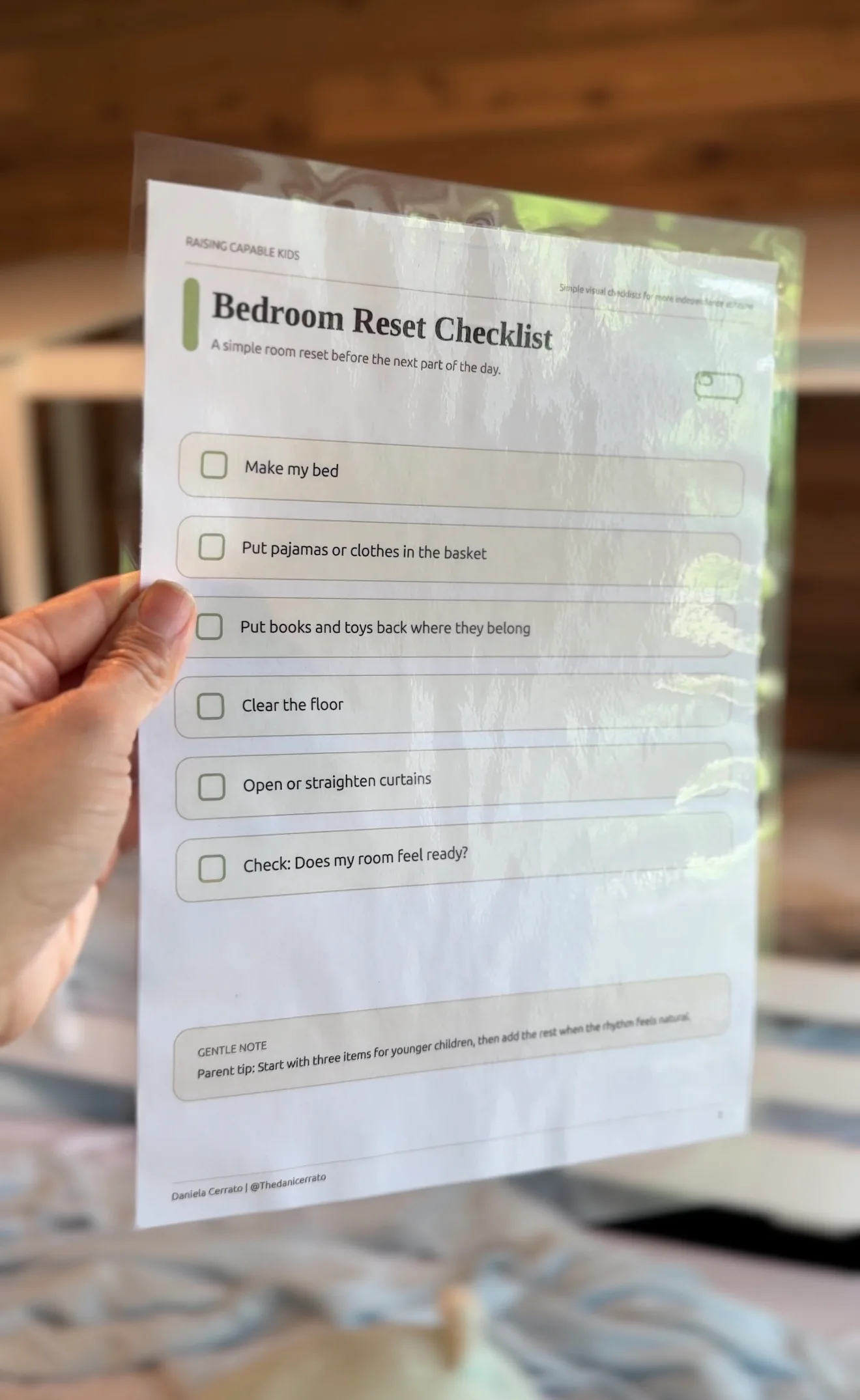
So I started creating what I call a simple home structure checklist.
And I want to be very clear about this:
This is not about turning children into little workers who carry the weight of the household.
This is about guiding them into respect—for their space, for their belongings, and for the people they live with.
It’s teaching them that home is something we all take care of together.
Not something one person carries alone.
A checklist like this might include simple, age-appropriate things like:
• Make your bed or straighten your sleeping area
• Put clothes in the hamper (not the floor “somewhere nearby”)
• Clear your dishes after eating
• Wipe down where you ate
• Return toys or learning materials to their place
• Do a “reset sweep” of your space before moving to the next activity
• Shoes and bags placed where they belong
• One small daily “help the home” task (like feeding pets or tidying a shared space)
Nothing complicated. Nothing overwhelming. Just consistent.
Because what I noticed in my classroom—and what I now see at home—is that kids don’t thrive with vague expectations like “be responsible.”
They thrive when responsibility is visible.
When “what’s expected” actually looks like something they can see and do.
When I didn’t have classroom structure, I wasn’t just disorganized—I was constantly correcting instead of teaching. And that same cycle happens at home when there’s no system in place. Parents become reminders instead of guides. Kids become dependent instead of capable.
But I also need to say this clearly: this should not feel like punishment.
A home structure is not meant to create pressure or tension. It’s meant to create peace. Predictability. Confidence.
And underneath that structure, there is something equally important—encouragement, connection, and yes, even reward systems that help reinforce what’s being learned. I’ll save that part for another day, because it deserves its own space.
But for now, I’ll just say this:
Structure didn’t make my classroom cold. It made it possible to learn.
And at home, it doesn’t make parenting rigid. It makes it calmer.
Not perfect.
Just more peaceful than before.